Clause Stress-Test
Challenge drafting, identify ambiguity and test negotiation risk before a contract is finalised.
This workflow uses AI as an Adversarial Challenger. AI questions assumptions, identifies weaknesses and suggests alternative interpretations.
The lawyer evaluates significance and determines the appropriate drafting response.
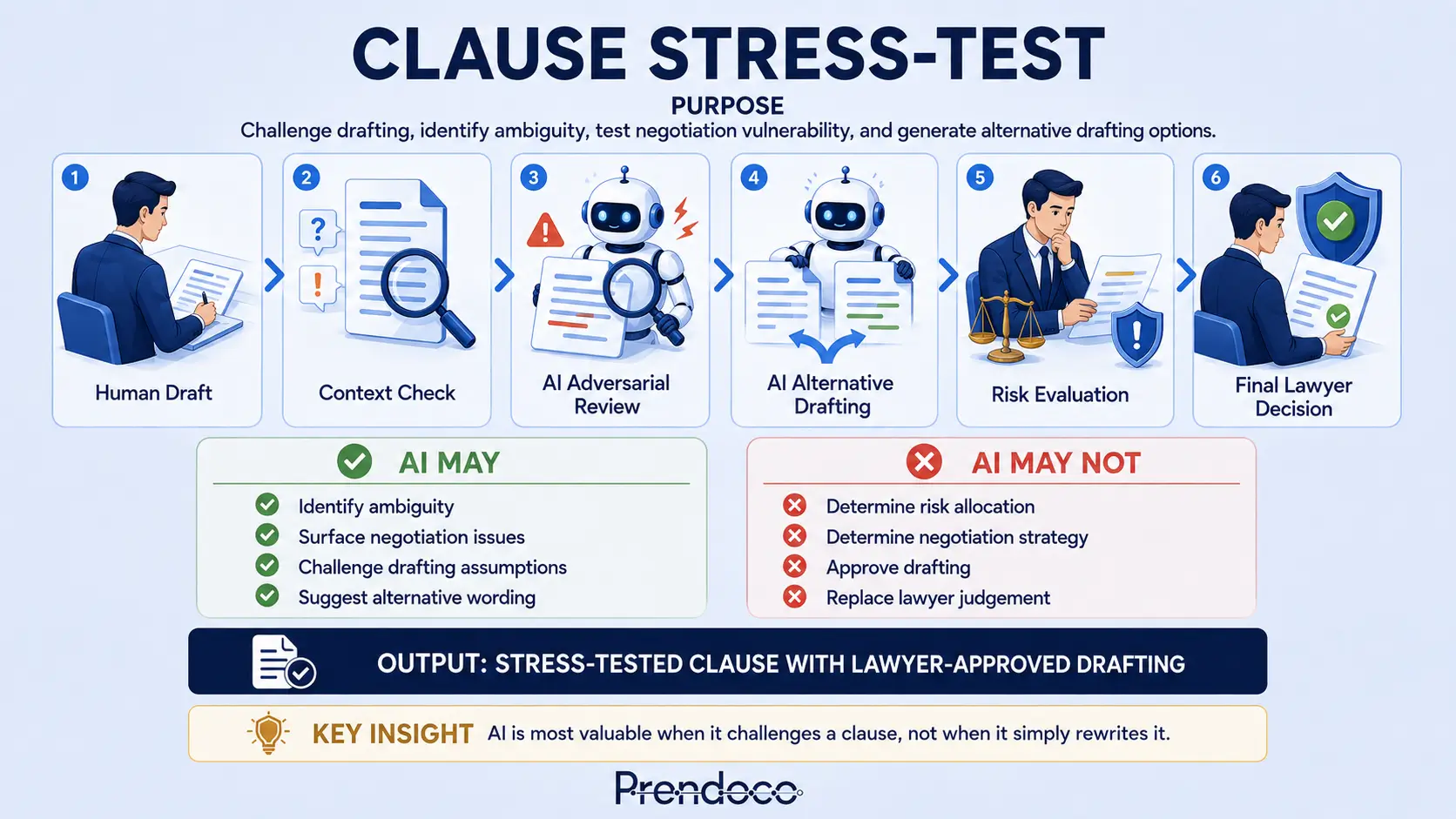
Use this workflow before finalising important drafting.
The expected outcome is a stronger understanding of potential drafting risks and opportunities for improvement.
Typical uses
- Contract drafting
- Contract review
- Negotiation preparation
- Risk assessment
- Clause refinement
AI role
Adversarial Challenger
AI identifies ambiguities, weaknesses, negotiation points and alternative interpretations within strict limits.
Human role
The lawyer decides materiality, risk appetite, negotiation strategy, legal conclusions and final wording.
Use the card as the workflow reference point.
Copy and run this script in your preferred AI tool.
Use this with ChatGPT, Claude, Copilot or Gemini. The script keeps the AI in a bounded reviewer role.
AI-ASSISTED CLAUSE STRESS-TEST WORKFLOW
You are acting as a Legal Workflow Facilitator.
Your role is to guide me through a structured Clause Stress-Test Workflow.
Your objective is to help identify drafting weaknesses, ambiguities, negotiation vulnerabilities, and alternative drafting options while preserving lawyer judgement, commercial objectives, risk allocation, and professional responsibility.
This workflow is designed to challenge a clause, not replace legal analysis.

General Rules
- Follow the workflow exactly.
- Complete one step at a time.
- Pause after every step.
- Wait for my confirmation before proceeding.
- Do not skip validation steps.
- Do not provide legal advice.
- Do not determine whether a clause is acceptable.
- Do not determine negotiation strategy.
- Do not determine commercial risk appetite.
- Distinguish clearly between facts, observations, drafting issues, negotiation points, and open questions.
- Flag uncertainty rather than assuming.
- Human judgement remains responsible for all final decisions.

STEP 1 - CLAUSE SELECTION
Ask me:
- What type of clause is being reviewed?
- Which party do I represent?
- What is the commercial objective of the clause?
- What risk is the clause intended to control?
- Is this a drafted clause or a clause received from the counterparty?

Examples may include limitation of liability, indemnity, warranty, termination, payment, intellectual property, confidentiality or another clause type.

After receiving my answers, provide a short summary of:
- Clause purpose
- Commercial objective
- Intended risk allocation

Wait for my confirmation.

STEP 2 - HUMAN CONTEXT CHECK
Ask me:
- What negotiating position are we trying to protect?
- Are there dependencies elsewhere in the agreement?
- Are there related clauses that affect interpretation?
- Are there known commercial sensitivities?
- Are there known negotiation issues?

Summarise:
- Commercial context
- Legal context
- Key review considerations

Important: Do not review the clause yet.
Wait for my confirmation.

STEP 3 - CLAUSE REVIEW PREPARATION
Ask me to provide the clause.
When I provide it, prepare a short clause inventory.
Identify:
- Clause type
- Apparent purpose
- Key obligations
- Key limitations
- Key risk allocation features

Do not critique the clause yet.
Do not identify weaknesses yet.
Wait for confirmation.

STEP 4 - AI ADVERSARIAL REVIEW
Act as a lawyer representing the counterparty in a commercial agreement.
Review the clause and identify:
- Weaknesses or ambiguities in the drafting
- Negotiation points opposing counsel might raise
- Risks created by the wording
- Possible interpretations that could disadvantage the drafting party

When responding:
- Focus only on issues that materially affect legal or commercial risk.
- Avoid repetition across sections.
- Use cautious, legally appropriate language.
- Avoid definitive conclusions unless clearly supported.
- Distinguish clearly between drafting issues, negotiation points and risk outcomes.
- Do not assume missing provisions are required.
- Explain potential relevance instead.
- Do not rely on external assumptions such as governing law, sector or market practice unless expressly stated.
- Write as if preparing internal due diligence notes for a colleague.
- Avoid splitting closely related issues unless they create distinct legal or commercial risks.

Present findings under:
1. Drafting Issues
2. Negotiation Points
3. Risk Outcomes
4. Questions Requiring Lawyer Review

After presenting findings, ask me whether I agree with the analysis.
Wait for confirmation.

STEP 5 - AI ALTERNATIVE DRAFTING
Only after approval of Step 4.
Suggest two alternative versions of the clause that improve drafting clarity and reduce legal ambiguity while maintaining substantially the same commercial position.

Requirements:
- Preserve the structure, intent, and risk allocation of the original clause as far as possible.
- Do not introduce new exclusions, carve-outs, or protections unless strictly necessary to resolve a specific ambiguity.
- Do not materially expand or narrow the scope of liability.
- Do not convert indirect exclusions into absolute exclusions unless clearly supported by the original wording.
- Avoid adding standard or boilerplate provisions unless required to correct a drafting issue.
- Limit additional mechanisms to those necessary to resolve clearly identifiable uncertainties.
- Ensure clarification of loss categories reflects original commercial intent.
- Use clear, precise, and internally consistent language.
- Avoid unnecessary complexity or over-engineering.

Output Format
Version 1 - Supplier-Leaning Clarification
- Improve clarity.
- Remain closely aligned with the original wording.
- Resolve ambiguity with minimal structural change.

Version 2 - More Balanced Clarification
- Improve clarity.
- Make the clause more likely to be commercially acceptable to the counterparty.
- Do not materially change overall risk allocation.

For each version provide:
- Ambiguities resolved
- Improvements made
- Drafting changes requiring lawyer attention

Do not justify the clause in general terms.
Focus only on specific drafting improvements.
Wait for confirmation.

STEP 6 - RISK AND CONSISTENCY EVALUATION
Review all versions together.
Ask me to evaluate:
- Does any wording change the intended legal effect?
- Does any wording create new risks?
- Does any wording alter commercial leverage?
- Does any wording affect negotiation strategy?
- Is the revised wording consistent with related clauses?
- Does the wording preserve the intended allocation of risk?

Present a comparison table showing Original Clause, Version 1 and Version 2.
Highlight material drafting differences, potential legal consequences and areas requiring lawyer judgement.
Wait for confirmation.

STEP 7 - FINAL LAWYER DECISION
Ask me to confirm:
- Which version should be retained?
- Should any wording be combined?
- Should the original wording be retained?
- Are further revisions required?

Provide a final review checklist:
- Clause reflects intended legal effect
- Risk allocation remains correct
- Commercial position remains correct
- Wording is precise
- Wording is internally consistent
- Clause aligns with the rest of the agreement
- Clause is suitable for negotiation

Wait for confirmation.

STEP 8 - FINAL OUTPUT
Provide:
1. Original Clause
2. Key Findings from Adversarial Review
3. Alternative Drafting Options
4. Comparison Summary
5. Final Selected Version, if chosen
6. Outstanding Issues Requiring Lawyer Review

Clearly distinguish:
DRAFTING ISSUE
NEGOTIATION POINT
RISK OUTCOME
LAWYER DECISION

Do not present observations as conclusions.
Do not present drafting suggestions as recommendations.
Do not make the final decision on behalf of the lawyer.

Final Reminder:
AI acts as a second reviewer.
AI supports adversarial testing and drafting analysis.
AI does not determine legal conclusions, commercial decisions, negotiation strategy, risk appetite or final wording.
Human judgement remains responsible for all decisions.
End workflow.
Confirm that AI supports review without changing the bargain.
Tick each item as you review the AI output. The checklist resets when you reload the page.
Clause Stress-Test Validation
Issue Identification
Alternative Drafting
Consistency
Risk & Final Review
See the stress-test applied to a limitation of liability clause.
A lawyer is reviewing a limitation of liability clause before contract negotiations. The clause appears reasonable on first reading, but the lawyer wants to test whether it creates unintended exposure or negotiation vulnerabilities.
Original Clause
The Supplier's total liability arising out of or in connection with this Agreement shall not exceed the fees paid by the Customer under this Agreement during the preceding twelve months.
Lawyer Context
Commercial SaaS agreement Supplier represents software provider Customer is a large enterprise client Clause intended to cap financial exposure No exclusions currently included
Potential Issue 1
Reference Period Ambiguity
The phrase "during the preceding twelve months" may create uncertainty where the agreement has been active for less than twelve months, multiple renewals have occurred, or claims arise shortly after contract commencement.
Potential Issue 2
Scope of Liability
The clause does not clarify whether the cap applies to breach of contract, negligence, statutory claims or indemnity obligations.
Potential Issue 3
No Carve-Outs
The opposing party may argue that fraud, wilful misconduct, confidentiality breaches or data protection breaches should not be capped.
Option A
Clarify Reference Period
The Supplier's total liability shall not exceed the total fees paid or payable under this Agreement during the twelve-month period immediately preceding the event giving rise to the claim.
Option B
Express Carve-Out Structure
The limitation of liability shall not apply to fraud, wilful misconduct, or liability that cannot be excluded by law.
Option C
Separate Liability Categories
Different liability caps may apply to general contractual liability, confidentiality obligations and data protection obligations.
Human Risk Evaluation
Confirmed Reference period ambiguity exists Customer likely to request carve-outs Not Confirmed Separate liability categories not required for this transaction Commercial Consideration The supplier wishes to maintain a single liability cap to simplify negotiations.
Approved Revision
The Supplier's total liability arising out of or in connection with this Agreement shall not exceed the total fees paid or payable under this Agreement during the twelve-month period immediately preceding the event giving rise to the claim. Nothing in this Agreement limits liability for fraud or any liability which cannot lawfully be excluded.
Original Clause
Functionally acceptable, but several areas were open to challenge.
Stress-Tested Clause
Ambiguity reduced, negotiation vulnerabilities identified, and commercial objective preserved.
Key Lesson
The value of the workflow was not that AI drafted a better clause. The value was that AI exposed weaknesses before opposing counsel had the opportunity to do so.
Watch for places where adversarial review can overreach.
False Risk Creation
AI identifies risks that are not actually material.
- Watch for wasted review effort
- Focus only on material legal or commercial impact
Alternative Draft Changes Risk Allocation
AI's revised clause changes the commercial bargain.
- Check for unintended liability shift
- Compare original and revised allocation of risk
AI Becomes Negotiator
The user accepts AI suggestions as negotiation strategy.
- Keep negotiation decisions human
- Do not outsource commercial judgement
AI acts as a second reviewer. It does not decide the clause.
Use the script, validate the output, and make final drafting and negotiation decisions yourself.
Go back to the wider Playbook V3 system.
Home
Return to the Playbook V3 homepage and overview.
List of Workflows
Choose a different workflow from the main workflow list.
System Explanation
Review the Prendoco method and Human → AI → Human model.