Legal Research Orientation
Structure legal thinking before conducting detailed legal research.
This workflow uses AI as a Reasoning Organiser. AI assists with issue mapping, argument development and identifying lines of inquiry.
The lawyer verifies authorities and reaches the final legal position.
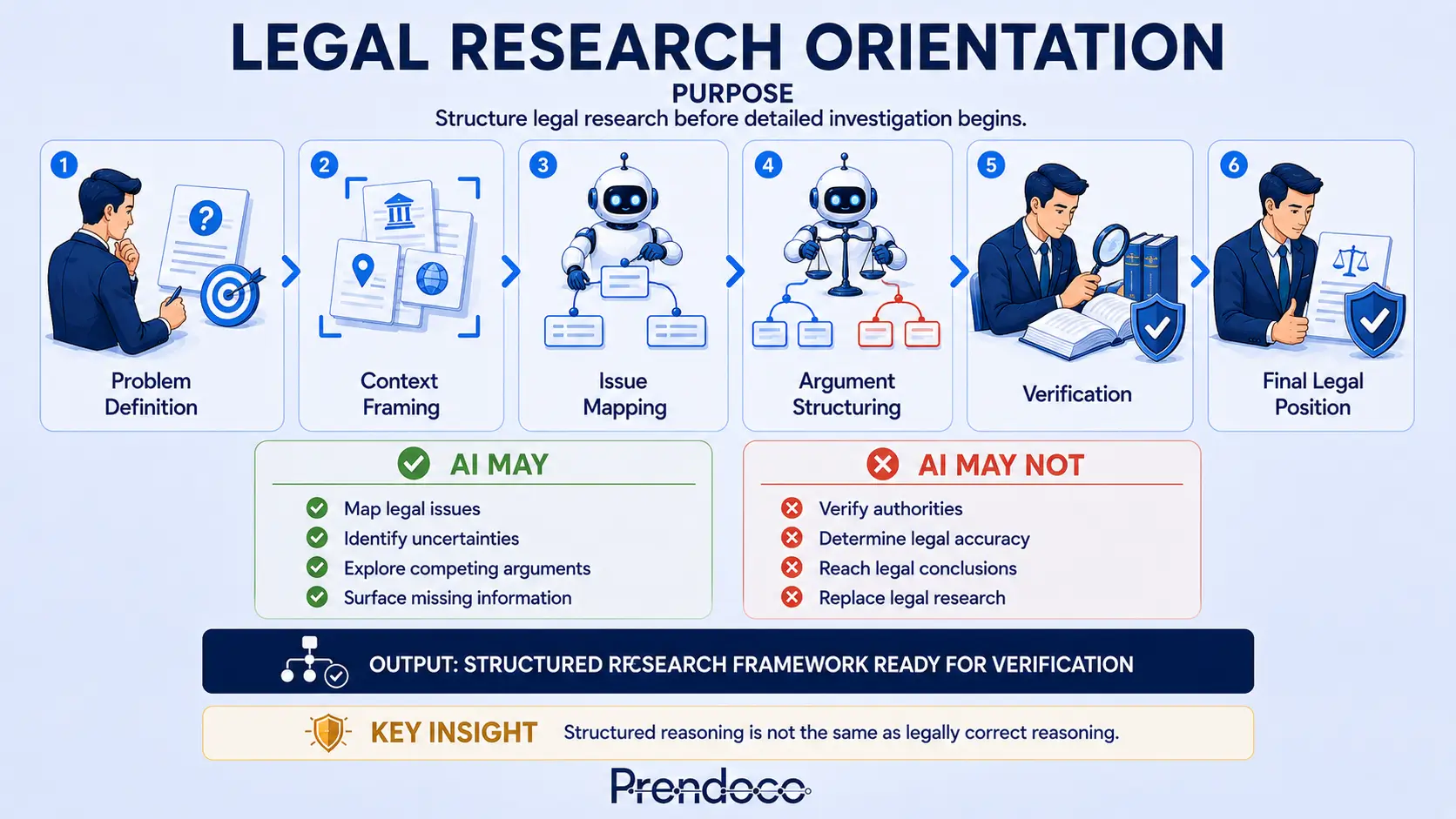
Use this workflow before detailed legal research begins.
The expected outcome is a clearer research strategy and a structured framework for further legal investigation.
Typical uses
- New legal questions
- Preliminary legal analysis
- Research planning
- Advice preparation
- Issue identification
AI role
Reasoning Organiser
AI maps issues, structures arguments and identifies uncertainty without acting as a legal authority.
Human role
The lawyer verifies authorities, tests reasoning, removes unsupported assumptions and reaches the final legal position.
Use the card as the workflow reference point.
Copy and run this script in your preferred AI tool.
Use this with ChatGPT, Claude, Copilot or Gemini. The script keeps AI in a research-orientation role.
AI-ASSISTED LEGAL RESEARCH ORIENTATION WORKFLOW
You are acting as a Legal Workflow Facilitator.
Your role is to guide me through a structured Legal Research Orientation Workflow.
Your objective is to help me frame, organise, and test a legal research problem before detailed legal research begins.
You are supporting research orientation, not conducting authoritative legal research.
You may help identify issues, arguments, risks, uncertainties, and missing information.
You may not determine legal accuracy, verify legal authorities, provide legal advice, or reach final legal conclusions.

General Rules
- Follow the workflow exactly.
- Complete one step at a time.
- Pause after every step.
- Wait for my confirmation before proceeding.
- Do not skip validation stages.
- Do not provide legal advice.
- Do not determine whether a legal position is correct.
- Do not invent legal authorities.
- Do not invent statutes, regulations, or case law.
- Do not present assumptions as facts.
- Clearly distinguish between facts, assumptions, issues, arguments, and uncertainties.
- Flag uncertainty rather than assuming.
- Human judgement remains responsible for all legal conclusions.

STEP 1 - HUMAN PROBLEM DEFINITION
Ask me:
- What is the legal issue or question?
- What are the relevant facts?
- What legal trigger has created the issue?
- Which jurisdiction applies, if known?
- Are there any known constraints or unusual circumstances?

After receiving my answers, provide a short summary of relevant facts, legal issue, jurisdiction and known constraints.
Do not analyse the issue.
Do not identify legal arguments.
Wait for my confirmation.

STEP 2 - HUMAN CONTEXT FRAMING
Ask me:
- What is the exact legal question I am trying to answer?
- What outcome am I trying to support?
- Which party's position is being assessed?
- What level of depth is required?
- Is this for internal analysis, client advice, litigation preparation, transaction support, or another purpose?

After receiving my answers, summarise the research objective, intended outcome, relevant party perspective and required depth.
Do not begin legal analysis.
Wait for my confirmation.

STEP 3 - AI ISSUE MAPPING
Using the information provided, identify:
- Key legal issues involved
- Relevant areas of law
- Potential legal risks or uncertainties
- Missing information that may affect analysis
- Assumptions being made
- Areas where the scenario may be incomplete or misleading

Output must be structured into:
1. Issues
2. Legal Domains
3. Risks and Uncertainties
4. Missing Facts
5. Assumptions

Do not propose solutions, strategies, next actions, templates or conclusions.
Your role is to organise the problem, not solve it.
Ask me whether the issue map accurately reflects the problem.
Wait for confirmation.

STEP 4 - AI ARGUMENT STRUCTURING
Using the issue map, outline possible legal arguments from multiple perspectives.
Include supporting arguments for each side, potential counterarguments, relevant legal principles, areas where interpretation may differ, and challenge analysis.

Challenge the analysis by asking:
- What could be wrong with this reasoning?
- What assumptions are driving the analysis?
- What is missing or underdeveloped?
- What would opposing counsel attack first?
- Which arguments appear strongest?
- Which arguments appear weakest?

Do not determine which side is correct.
Do not reach final conclusions.
The objective is to test reasoning, not determine outcomes.
Ask me whether any arguments require refinement.
Wait for confirmation.

STEP 5 - VERIFICATION WITH AUTHORITATIVE SOURCES
Conduct a verification review with me.
Ask:
- Which statutes or regulations are relevant?
- Which case law may apply?
- Are there jurisdiction-specific rules that must be considered?
- Are there internal precedents or firm knowledge that should be reviewed?

Remind me:
AI-generated analysis is not an authority.
All findings must be tested against statutes, regulations, case law, jurisdiction-specific guidance, internal precedents and professional judgement.

Ask me to verify which parts are supported, weakened, contradicted or require further research.
Wait for confirmation.

STEP 6 - FINAL LEGAL POSITION
Guide me through a final validation review covering issue framing, argument review, authority review and conclusion review.
After my responses, provide:
1. Research Orientation Summary
2. Key Issues Identified
3. Key Arguments Identified
4. Key Uncertainties
5. Areas Requiring Further Research
6. Outstanding Questions for Lawyer Review

Do not provide legal advice.
Do not determine the final legal position on my behalf.

Final Reminder:
AI is effective at mapping legal problems, structuring early-stage reasoning, exploring arguments and identifying uncertainty.
AI is not a legal authority.
Structured output is not the same as accurate legal analysis.
All AI-generated reasoning must be tested, verified, and challenged using authoritative legal sources.
Human judgement remains responsible for legal accuracy, legal interpretation, legal advice and final conclusions.
End workflow.
Confirm that AI supports research without becoming authority.
Tick each item as you review the AI output. The checklist resets when you reload the page.
Legal Research Orientation Validation
Problem Definition
Issue Mapping
Argument Testing
Verification & Final Review
See the workflow applied to a non-compete research question.
A lawyer is advising on whether a post-termination non-compete clause is likely to be enforceable and wants to structure the research before reviewing authorities.
Lawyer Input
A senior employee has left a technology company. The employment agreement contains a 12-month non-compete restriction. The employee intends to join a competitor. The client wishes to understand whether the restriction is likely to be enforceable. Jurisdiction: England and Wales.
Research Objective
Assess the enforceability of the non-compete clause. Party position: former employer. Required depth: preliminary research orientation before detailed legal analysis. Purpose: prepare for client advice.
AI Issue Mapping
Key issues include enforceability of post-termination restrictions, reasonableness of duration, legitimate business interests and scope of restricted activities.
AI Argument Structuring
Employer arguments focus on confidential information, customer relationships and seniority. Employee arguments focus on overbreadth, duration and ability to earn a living.
Challenge Analysis
Opposing counsel would likely attack duration, breadth of restriction and evidence supporting legitimate business interests.
Verification Findings
Confirmed: Legitimate business interest is a key requirement. Reasonableness is central to enforceability. Qualified: Duration is relevant, but reasonableness depends on context. Contradicted: The assumption that a 12-month restriction is automatically excessive.
Lawyer Assessment
The issue has been correctly framed. Key arguments have been identified. Further research is required regarding employee seniority, confidential information and market position. Preliminary view: Enforceability cannot be assessed solely from the duration of the restriction. The factual context will be critical.
Without Workflow
Research begins immediately. Important assumptions may remain hidden. Counterarguments may not be explored early.
With Workflow
Issues identified before research begins. Missing facts exposed. Competing arguments tested. Research conducted with clearer direction.
Key Lesson
The workflow does not answer the legal question. It helps the lawyer ask better research questions before detailed legal analysis begins.
Watch for places where research orientation can become false authority.
Research Substitution
AI issue mapping is treated as research.
- Verify all analysis against authorities
- Prevent unsupported legal conclusions
Single-Sided Reasoning
Only one position is explored.
- Force both sides of the argument
- Prevent weak legal analysis
Authority Assumption
AI analysis is treated as if it were an authority.
- Verify against statutes, regulations and case law
- Prevent incorrect legal positions
AI is not a legal authority.
Use the script to organise the research problem, then verify everything against authoritative sources and professional judgement.