
AI Competence Is Not Prompt Confidence
Better prompts can make AI outputs look more useful. But legal AI competence requires something deeper: task judgement, input control, validation, supervision, and human final responsibility.
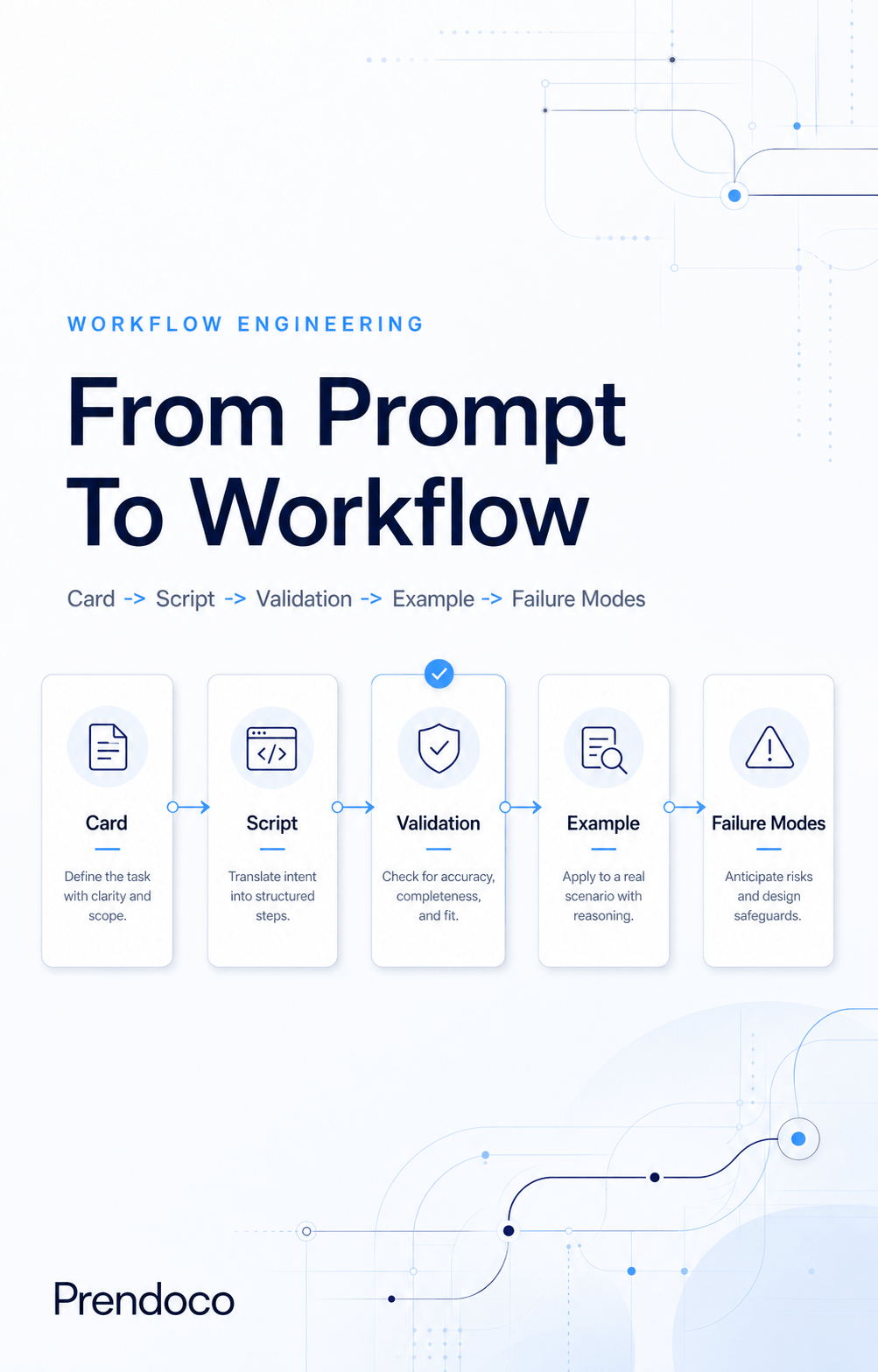
Many lawyers are getting better at prompting. That is useful. But it is not the same as AI competence.
This distinction matters because a confident AI user can still be an unsafe AI user.
They may know how to get a polished output.
They may know how to ask follow-up questions.
They may know how to make the answer shorter, clearer, more formal, more commercial, or more client-friendly.
But legal work requires more than output quality.
It requires judgement about whether the task is suitable, whether the input is complete, whether the output is reliable, whether the source material supports it, whether the wording preserves legal meaning, and whether a lawyer can responsibly rely on it.
That is a different skill.
Prompt confidence is about using the tool fluently.
AI competence is about using the tool safely, consistently, and appropriately inside real legal work.
The Problem With Prompt Confidence
Prompt confidence is attractive because it feels practical.
A lawyer learns a few useful patterns:
- ask for a summary
- ask for a table
- ask for a redraft
- ask for risks
- ask for plain English
- ask for alternative wording
- ask the tool to act as a reviewer
The outputs improve quickly.
That creates a sense of progress.
And in many cases, there is progress. A better prompt can make AI more useful. It can reduce vague answers. It can help a lawyer structure a task more clearly. It can save time at the first-pass stage.
But prompt confidence has a weakness.
It can make the user feel in control before the workflow is actually controlled.
In legal work, an answer that looks clear is not necessarily correct. A draft that reads well may still change the legal position. A summary that appears organised may still miss a qualification.
The issue is not that prompting is unimportant.
The issue is that prompting is only one part of the work.
What AI Competence Actually Means
AI competence means knowing how to use AI within professional responsibility.
For lawyers, that usually includes several capabilities.
- 01Task judgement
The lawyer decides whether AI is appropriate for the work at all. Some tasks are suitable for AI assistance. Some are suitable only at an orientation or drafting stage. Some should not be delegated to AI in any meaningful way.
- 02Input control
The lawyer understands what information the tool requires, what information should not be included, what confidentiality boundaries apply, and whether the source material is complete enough for the task.
- 03Role definition
The lawyer decides whether AI is summarising, comparing, drafting, testing ambiguity, identifying possible issues, or helping with structure. Those roles require different controls.
- 04Output evaluation
The lawyer knows how to review the result specifically. A contract summary is checked differently from a client email. A clause stress-test is checked differently from a legal research orientation.
- 05Escalation judgement
The lawyer knows when uncertainty, missing information, weak source support, or possible meaning drift should stop the workflow and trigger human review.
That is competence.
It is not the ability to produce an impressive answer.
It is the ability to decide what should happen before, during, and after AI produces the answer.
Why This Matters In Legal Work
Legal work is not only about text.
It is about meaning, reliance, responsibility, risk, context, and judgement.
That makes legal AI different from general productivity use.
If AI rewrites a marketing paragraph, the main question may be whether it sounds better.
If AI rewrites a contractual clause, the main question is different.
- Has it preserved the obligation?
- Has it changed the standard?
- Has it altered the timing?
- Has it removed a qualification?
- Has it shifted risk from one party to another?
- Has it made the position sound more certain than it is?
The output may be fluent and still unsafe.
That is why AI competence cannot be reduced to prompt quality.
A good prompt may produce cleaner language.
But legal competence requires the lawyer to ask a harder question:
Can this output be used responsibly in this workflow?
That question cannot be answered by the model alone.
The Difference Between Usage And Competence
One of the most common mistakes in AI adoption is treating usage as evidence of competence.
Someone uses AI frequently.
They get useful outputs.
They are comfortable with the tool.
They may even be the person others ask for help.
But when the work is examined more closely, several gaps often appear:
- outputs are not checked consistently
- sources are not verified
- assumptions are not captured
- AI use is not visible to reviewers
- different people use different standards
- confidence varies more than quality
- no one has defined when the workflow should stop
That is not competence.
It is active use.
There is nothing wrong with active use as a starting point. Most capability develops through experimentation.
But legal teams should not confuse experimentation with a reliable operating model.
AI competence exists when people can use AI in a way that is repeatable, supervised, and appropriate to the task.
That requires structure.
Prompting Is A Skill Inside A Workflow
The better way to think about prompting is not to dismiss it.
Prompting matters.
But it should sit inside a workflow.
For example, a lawyer using AI to review a client email should not simply ask:
Make this clearer and more professional.
That may produce a better email.
But it does not protect legal meaning.
A more controlled workflow would start earlier:
- Define the purpose of the email.
- Identify the legal or commercial position that must be preserved.
- Decide what AI is allowed to improve.
- Decide what AI must not change.
- Ask AI for a revised draft within those limits.
- Compare the revised draft against the original.
- Check tone, certainty, obligations, deadlines, and legal meaning.
- Make a final human decision before sending.
Prompting still appears in that workflow.
But it is not carrying the whole burden.
The workflow tells the prompt what role it has.
That is the safer model.
Confidence Can Hide Missing Validation
The most dangerous AI outputs in legal work are not always obviously wrong.
Often, they are polished.
They read smoothly.
They organise the material well.
They sound reasonable.
They create confidence.
That is precisely why validation matters.
A lawyer may look at a clear output and feel that the work is largely done. But clarity is not proof. Structure is not proof. Fluency is not proof. A confident tone is not proof.
The output still has to be checked against the task.
For a legal research orientation, that may mean verifying sources, jurisdiction, currency, and whether the source actually supports the point.
For a contract summary, it may mean checking the summary against the agreement, schedules, annexes, definitions, and exceptions.
For clause drafting, it may mean comparing the proposed wording against the intended risk allocation.
For client communication, it may mean checking whether the tone has become too certain, too soft, too aggressive, or too simplified.
Validation is not a general reminder to be careful.
It is a task-specific process.
Without it, prompt confidence can become overconfidence.
Competence Includes Knowing When Not To Use AI
One of the clearest signs of AI competence is restraint.
A competent user does not ask:
How can I use AI for this?
They ask:
Should AI be used here at all?
Sometimes the answer is yes.
AI may be useful for first-pass orientation, structure, comparison, drafting support, simplification, or issue spotting.
Sometimes the answer is no.
The task may involve sensitive material that cannot be placed in a particular tool. The facts may be too incomplete. The legal judgement may be too context-dependent. The risk of misleading confidence may be too high. The time saved may not justify the review burden.
This is not resistance to AI.
It is professional judgement.
Legal AI competence includes the ability to stop.
That is often missing from prompt-led training.
What Legal Teams Should Look For
If a legal team wants to understand whether it is building AI competence, it should look beyond who is good at prompting.
Better questions include:
- Do people know which tasks are suitable for AI assistance?
- Do they know what material can and cannot be used?
- Do they define the AI role before generating output?
- Do they use shared workflows or individual habits?
- Do they validate outputs against source material?
- Do they know the common failure modes for each task?
- Do they make AI use visible to reviewers?
- Do senior lawyers know how to supervise AI-assisted work?
- Do people know when to stop, escalate, or reject the output?
- Is the final legal judgement clearly human?
These questions reveal the difference between confidence and competence.
A team may be confident because people are using AI regularly.
But if validation is inconsistent, supervision is unclear, and workflows are undefined, the competence layer is still weak.
Why This Is An Implementation Problem
Many organisations treat AI competence as a training issue.
Training is important.
But competence is not created by training alone.
It is created when training changes how work is done.
That means legal teams need more than general sessions on AI risk, prompting, and policy.
They need workflow implementation.
They need to decide how AI should be used in specific tasks:
- client email review
- contract summary
- clause stress-testing
- legal research orientation
- due diligence review
- internal knowledge work
- drafting and redrafting
Each workflow needs its own boundaries, validation points, and failure modes.
This is where AI competence becomes practical.
Prompt confidence
I know how to use the tool.
AI competence
I know how to use the tool responsibly in this task.
From Individual Skill To Shared Standards
There is another reason prompt confidence is too narrow.
It is individual.
One lawyer may be excellent at using AI. Another may be cautious. Another may be overconfident. Another may avoid the tool completely.
If the organisation depends only on individual prompting ability, quality will vary.
That creates a supervision problem.
Senior lawyers cannot realistically review every prompt, every iteration, and every private AI exchange. But they can supervise a defined workflow.
They can ask:
- Was this the right workflow?
- Were the correct inputs used?
- Was AI asked to perform the right role?
- Were sources checked?
- Were changes validated?
- Were assumptions identified?
- Was final judgement retained?
That is easier to supervise.
It also creates a shared standard across the team.
AI competence is not just personal fluency.
It is organisational reliability.
A Practical Starting Point
The useful starting point is not to build a broad AI competence programme immediately.
Start with one workflow.
Choose a task that is common, valuable, and narrow enough to control.
For example:
- reviewing a client email before it is sent
- preparing an internal contract summary
- testing a clause for ambiguity
- creating a first-pass research map
- extracting issues from a document set
Then define the workflow:
- what the task is for
- what AI may do
- what AI may not do
- what the lawyer must define first
- what the output should look like
- what must be checked
- what failure modes are predictable
- what final decision remains human
Then test it.
Use realistic but safe examples.
Observe where the workflow works.
Observe where it fails.
Refine the process.
That is how competence develops.
Not from prompt confidence alone, but from repeated, structured, validated use.
Conclusion
Prompt confidence is useful.
But it is not enough.
In legal work, AI competence means something deeper.
It means knowing when AI is appropriate, how to frame the task, what context is required, how to control the input, how to review the output, how to detect failure modes, when to escalate, and where human judgement remains essential.
The shift is important:
- from better prompts to better workflows
- from individual confidence to shared standards
- from fluent output to validated work
- from tool use to professional competence
That is where legal AI adoption becomes more serious.
Not when lawyers become confident asking AI questions.
When they become competent deciding what should happen with the answers.
Move from prompt confidence to structured AI competence.
Prendoco helps lawyers and legal teams use AI workflows for lawyers with defined task boundaries, validation points, failure-mode awareness, and lawyer-controlled judgement. The Legal AI Workflow Playbook V3 is a practical starting point for building that competence around real legal tasks.