
Legal AI Workflow Playbook V2.1
Legal AI Workflow Playbook V2.1 is a practical playbook of repeatable, risk-aware workflows that help lawyers use AI for drafting, review, analysis and internal execution—without outsourcing legal judgement.
- PDF download
- 9 practical legal AI workflows
- Built for controlled, lawyer-led use
Legal Workflow Playbook
Drafting. Review. Risk analysis. Summary. Negotiation.
This is for you if…
You already use AI informally
But you want more reliable outputs, less drift, and clearer working discipline.
You need repeatable review
Not random prompting. You need validation structure, checkpoints, and consistency.
You want help without losing control
The workflows are designed to keep clarity, tone, caution, human responsibility, and final legal judgement intact.
Most lawyers don’t have an AI problem. They have a workflow problem.
AI tools can produce useful text, but without structure they also create uncertainty, tone issues, shallow reasoning, unsupported assumptions, and review burden.
- Outputs lack professional tone, certainty, or risk framing
- Teams use AI inconsistently with no shared structure
- Drafting and review happen without a validation layer
- Human judgement gets blurred instead of protected
Legal AI Workflow Playbook V2.1 includes 9 practical workflows.
Each workflow is written to be used immediately: purpose, overview, steps, prompt constraints, and a clear “human remains responsible” boundary.
AI-Assisted Client Email Draft Review
Draft and review structure for clear, cautious client communication.
AI-Assisted Clause Stress Test
Adversarial clause testing, alternative wording, and human risk evaluation.
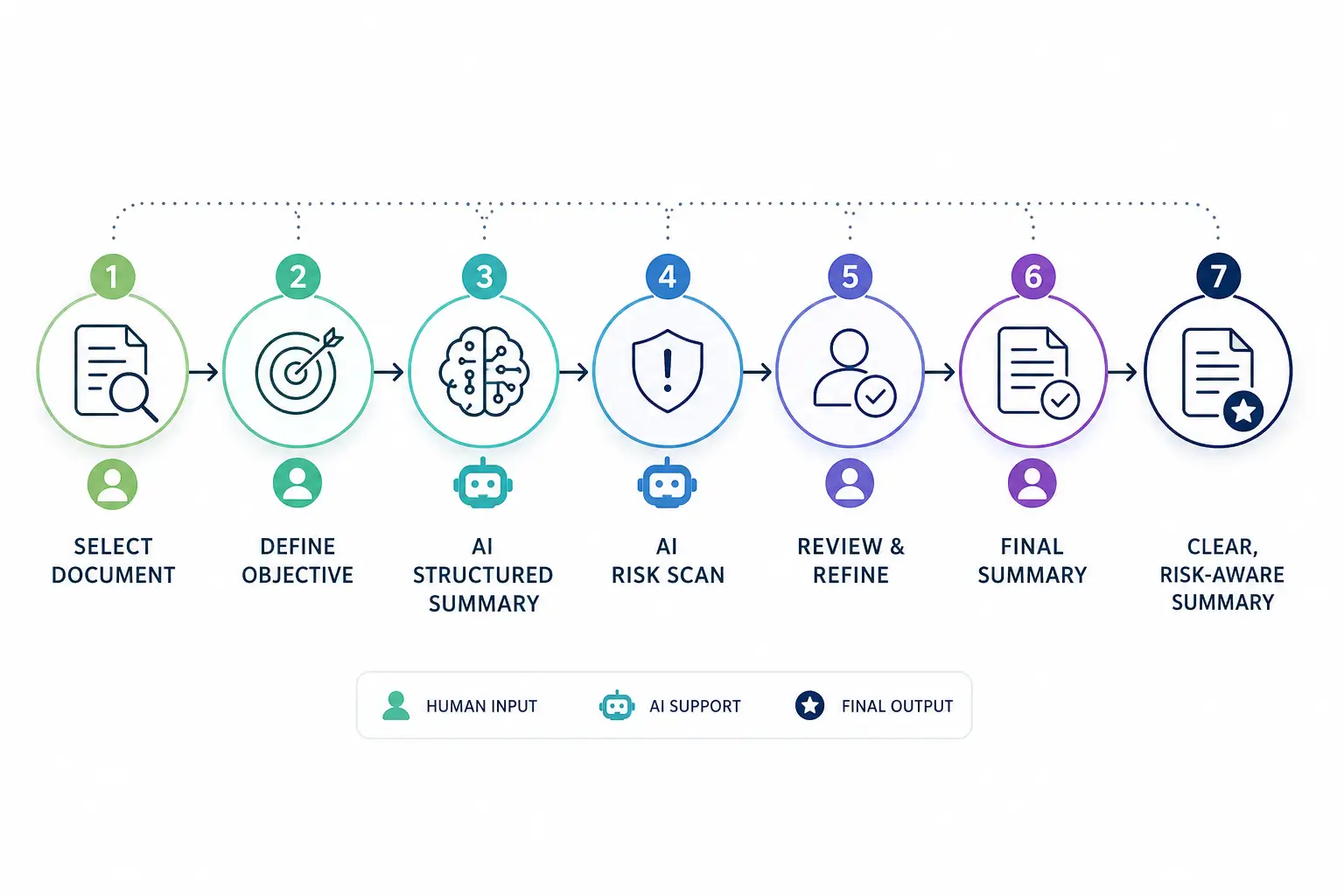
AI-Assisted Contract Summary
Structured summary, risk scan, and human verification.
AI-Assisted Contract Comparison
Extract, compare, and evaluate risk shifts with human final assessment.
AI-Assisted Legal Research Orientation
Issue mapping, argument structuring, and verification against authoritative sources.
AI-Assisted Due Diligence Workflow
Structured issue spotting, cross-document analysis, and human adversarial review.
AI-Assisted Natural Language Drafting
Clarity and tone adjustment while preserving legal meaning and caution.
AI-Assisted Meeting Notes to Legal Actions
Turn notes into decisions, actions, legal issues, and human review points.
AI-Assisted SPA Negotiation Workflow
Change analysis, negotiation intent, strategy, and human-reviewed action planning.
The operating principle is simple.
AI is used to structure, extract, compare, and draft options — but not to replace legal judgement or become the final authority.
Human defines the task and context
AI performs a structured assistance step
Human verifies, stress-tests, and finalises
Built around how legal work actually happens.
This playbook focuses on drafting, review, negotiation, internal follow-up, due diligence, and research orientation — with explicit structure to reduce drift, overconfidence, and unsupported outputs.
The focus is workflow reliability and legal communication clarity, not generic AI education.
Questions before you buy
Is this legal advice?
No. The workflows are educational and operational. Final responsibility remains with the lawyer.
Do I need a specific AI tool?
No. The workflows describe structured steps and prompt constraints. They are designed as a workflow layer, not tool-specific hype.
How do these workflows reduce risk?
They introduce structure, comparison discipline, verification against authoritative sources, and human final review.
What’s different from prompt packs?
These are repeatable processes with constraints, sequencing, review layers, and clear professional responsibility boundaries.
Use AI in legal work — without losing control.
Get Legal Workflow Playbook V2.1 and start using structured, lawyer-led AI workflows today.