
AI Contract Summaries Need Validation, Not Blind Trust
A practical method for checking AI contract summaries against source clauses, preserving conditions, finding omissions and reviewing corrections before use.
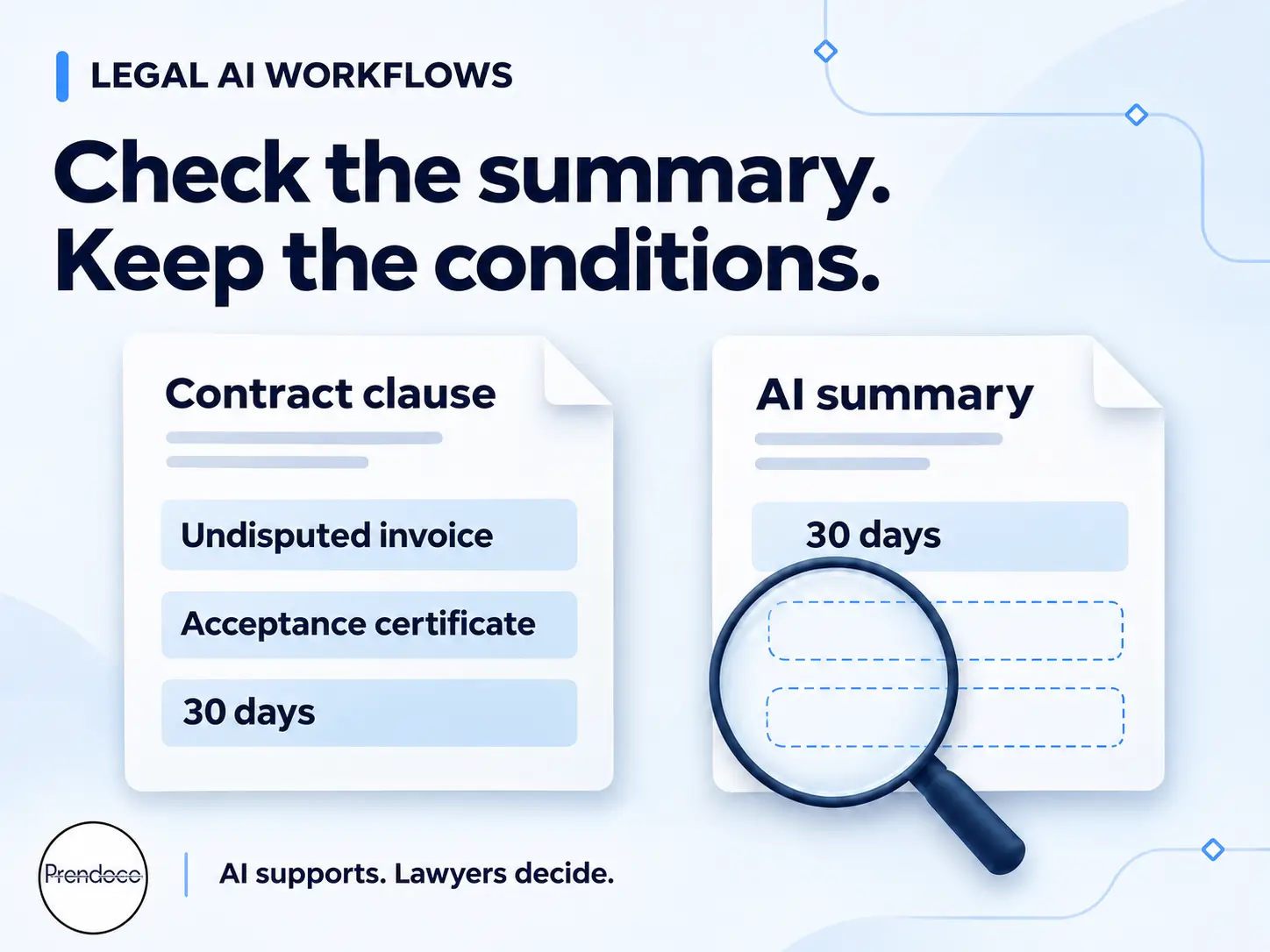
A contract summary can be easy to read and still give the reader the wrong understanding of an obligation.
The payment period may be correct. The price may be correct. The summary may even point to the right clause.
But if it leaves out the condition that makes payment due, it has changed what the reader takes away.
That is why asking AI for a clear summary is only part of the task. The workflow also needs a way to check whether the summary preserves the meaning that matters for its intended use.
A small omission can change the working understanding
Consider this deliberately simplified, fictional contract provision:
Clause 8.2: The Customer must pay each undisputed invoice within 30 days after receiving both the invoice and the acceptance certificate required by Schedule 2.
Suppose the AI summary says:
Payment is due within 30 days of receipt of an invoice.
The sentence is concise. It includes the correct number of days. It sounds like a reasonable payment summary.
But it leaves out two points: the invoice must be undisputed, and the payment period depends on receipt of the acceptance certificate as well as the invoice.
For someone preparing a payment timetable, those omissions matter. The summary gives them a different trigger for the deadline.
A closer summary of this supplied provision would be:
Undisputed invoices are payable within 30 days after the Customer receives both the invoice and the acceptance certificate required by Schedule 2.
That wording preserves the stated conditions. It still leaves further review to do: what does Schedule 2 require, and is it available in the document set?
This example illustrates a comparison method. It is not an interpretation of a real agreement or an AI performance test.
Decide what the summary will be used for
“Summarise this contract” leaves a great deal unstated.
An initial orientation note, a client briefing and an operational obligations register serve different purposes. Each needs a different level of detail and review.
Before generating the summary, define its audience, the decision or activity it will support, and the topics it must cover.
For example:
Prepare an internal payment-obligations summary for the lawyer reviewing this supply agreement. Identify payment amounts, deadlines, triggers, conditions, exceptions and relevant cross-references. Separate what the supplied documents state from questions requiring further review.
This gives the work a clearer boundary. It also helps the reviewer decide which omissions would make the summary unsuitable.
Establish the source set
The reviewer needs to know what material the summary is based on.
Record the agreement version and the schedules, amendments or other documents supplied. If a referenced document is missing, make that absence visible. Where the tool cannot read a page or extract its text reliably, treat that as a source problem to resolve.
In the fictional example, a reference to Schedule 2 should lead to a question if that schedule has not been provided. The summary should not fill the gap with an assumed acceptance process.
Use an AI environment approved for the material involved, within the organisation’s agreed information-handling arrangements.
Make the output easier to check
A useful draft can give the reviewer a route back to the source.
Ask for each material summary point to include a clause reference, its conditions and exceptions, and any unresolved question. Keep extracted terms separate from suggested implications or recommendations.
For our fictional provision, a review entry could look like this:
| Item | Draft entry |
|---|---|
| Source | Clause 8.2; Schedule 2 referenced |
| Obligation | Customer pays undisputed invoices |
| Timing | Within 30 days after receiving both the invoice and the required acceptance certificate |
| Open point | Inspect Schedule 2 to establish the certificate requirements |
The reference and structure support checking. The reviewer must still open the source and confirm that the entry represents it accurately.
Check in both directions
Reading the summary against the contract asks: is each statement supported?
Reading the relevant contract provisions against the summary asks: what has been left out?
Both questions matter. Every sentence in a summary could be supportable while an important obligation or exception is absent.
For the agreed scope, check:
- Parties and responsibility: who must do what, and for whom?
- Amounts and timing: are figures, units, deadlines and triggering events preserved?
- Conditions and exceptions: what must happen first, and when does the general statement change?
- Definitions and cross-references: does another provision qualify the wording?
- Coverage and uncertainty: are required topics missing, or unresolved points presented as settled?
These checks should be adapted to the task. A payment summary needs particular attention to payment mechanics. A termination summary needs its own review plan around rights, triggers, notice requirements and consequences.
Turn important requirements into explicit checks
Recent assisted work on Prendoco Workflow Studio exposed a useful design lesson: a requirement can be captured in a task description without becoming a separate review check.
The same problem can arise with contract summaries.
An instruction such as “preserve the important qualifications” expresses an intention. For the payment example, the reviewer needs something more concrete:
Check that the summary retains the undisputed-invoice qualification and both documents required to trigger the payment period.
That gives the reviewer a defined comparison to make. If Schedule 2 is missing, record the outstanding question and decide whether it prevents the proposed use of the summary.
The person designing the workflow should inspect how each important requirement becomes an action, a check or a decision.
Recheck corrections before using the result
If the first summary omits the acceptance certificate, the reviewer can request a bounded correction: restore that condition, preserve the undisputed-invoice qualification and leave unaffected entries unchanged.
The revised output then needs checking again. Did it fix the omission? Did it preserve the other condition? Did any unrelated wording change?
Another AI pass can help identify possible discrepancies, but agreement between AI outputs does not establish that the source has been represented correctly. The responsible reviewer still needs to examine the relevant material.
Keep the review decision attached to the version actually checked. Record its intended use, material limitations and unresolved points. An internal orientation summary may have a different approval boundary from a document intended for client circulation.
A reusable method needs a fresh review each time
The useful outcome is a method the team can repeat: define the purpose, establish the sources, generate a reviewable draft, check accuracy and coverage, correct within scope, and decide whether the checked version is suitable for use.
Each new contract brings different wording, dependencies and missing information. The method carries forward; the conclusions need fresh examination.
This also gives a team something practical to evaluate. Record the omissions found, the corrections required and the effort involved in review. A polished draft alone does not establish that the overall task became quicker or easier.
An AI contract summary should help a lawyer work through the agreement while preserving a clear route back to its terms.
If your team is using AI for contract summaries, which parts of the review would you most want to make consistent?
Discuss one contract-summary workflow.
Prendoco helps legal teams make recurring tasks explicit: the inputs, AI role, review checks, corrections and human decisions.
If you would like to discuss one contract-summary workflow, contact info@prendoco.com with a brief description of the task. Please leave confidential documents out of the initial enquiry.