
After AI corrects a legal draft: what exactly are you approving?
You spot a problem in an AI-assisted draft. You ask for a correction. A revised version appears, accompanied by a reassuring explanation that the issue has been addressed.
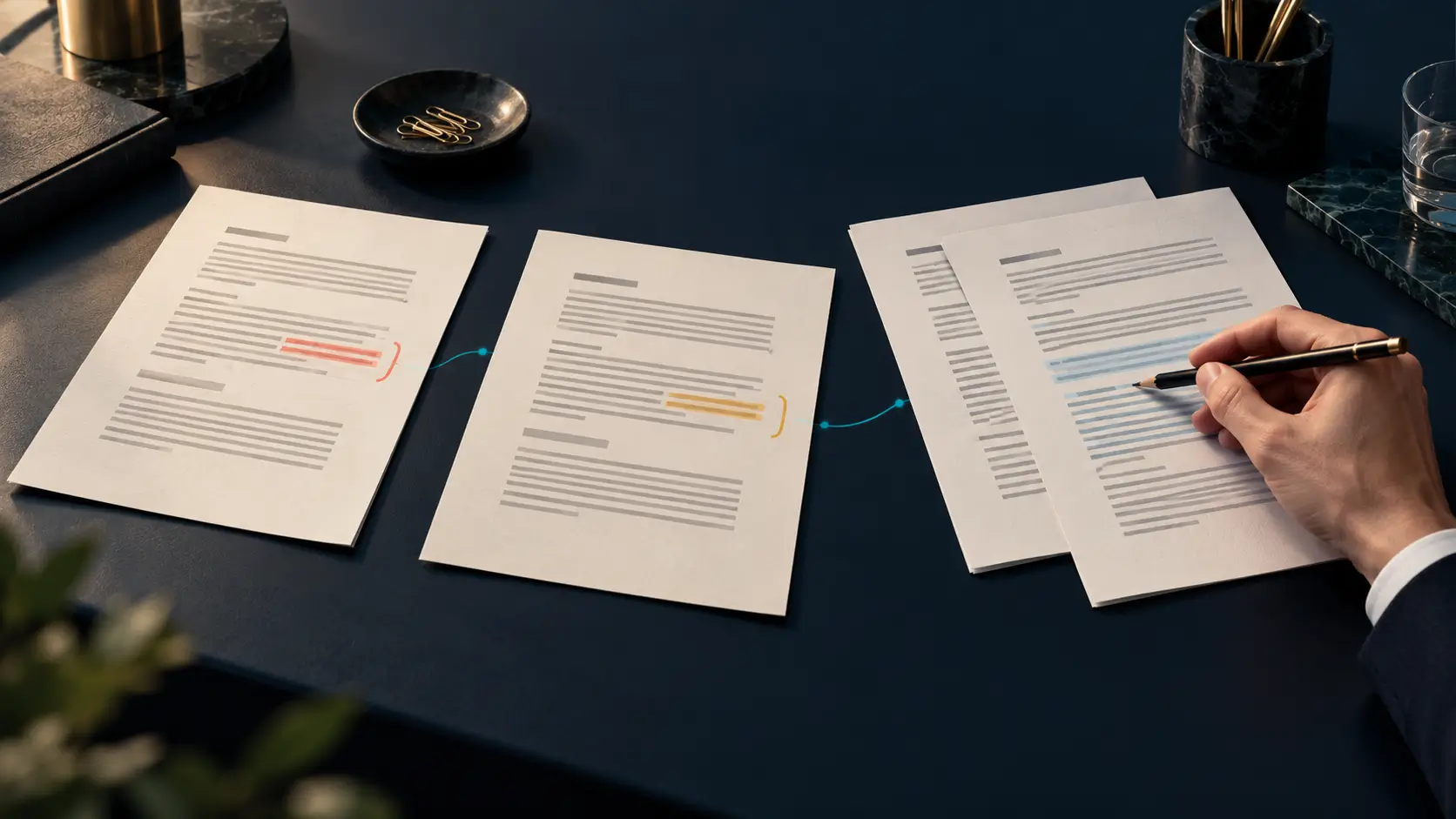
What do you check next?
It is tempting to look at the sentence you flagged, confirm that it has changed, and move on. But the revised draft may contain other changes. A qualification may have disappeared. A question may have become a conclusion. The correction may be right while the email is still unsuitable to send.
The useful question is specific: does this exact version now do the job you intended?
Our article on using AI for legal drafting without increasing risk explains the broader problem of polished wording changing meaning. Here, we will follow one correction through to a final review decision.
Start with the facts and the permitted task
The following example is entirely fictional. The source notes, drafts and reviewer decisions are constructed to illustrate a review method. They are not client work, legal advice or results from a product test.
A lawyer is preparing a short update to a client about a proposed delivery arrangement. For this example, the lawyer has checked and adopted these source notes:
- The supplier’s email proposes delivery on 12 November. The date has not been agreed.
- The client has asked for delivery by 8 November. The supplier has not responded to that request.
- The lawyer has not reviewed whether the contract gives the client a remedy for delay.
- The immediate purpose is to update the client and ask whether the lawyer should chase the supplier. It is not to advise on remedies.
The AI’s task is to turn those notes into a short email. It may improve the structure and wording. It must preserve the distinction between a proposal and an agreement, retain the unanswered request, and leave the remedy question unresolved.
Those boundaries give the reviewer something concrete to check.
Version 1: the first draft
The supplier has agreed to deliver on 12 November. We have asked for delivery by 8 November and are awaiting a response. We have not yet reviewed whether the contract gives you a remedy for delay. Please let us know whether you would like us to chase the supplier about your requested date.
The first sentence is wrong. The source records a proposal, not an agreement.
The reviewer rejects Version 1 and requests a limited correction:
Replace the statement that delivery on 12 November is agreed. Make clear that the supplier has proposed that date and it remains unagreed. Preserve the other facts, the qualification about contractual review and the question to the client.
Version 2: the correction introduces a different problem
The supplier has proposed delivery on 12 November, but that date has not been agreed. We have asked for delivery by 8 November and are awaiting a response. You have no remedy for delay at this stage. Please let us know whether you would like us to chase the supplier about your requested date.
The original error is fixed. The opening now matches the source notes.
But the third sentence has changed. “We have not yet reviewed whether…” has become “You have no remedy…”. A statement about work still to be done has become a substantive conclusion.
There is no support for that conclusion in the supplied material. Adding “at this stage” does not restore the missing qualification.
Version 2 is therefore not approved for sending. The reviewer retains it as a rejected draft and identifies the new issue.
This is why checking only the corrected sentence is insufficient. The review needs two comparisons: the revised draft against the source material, and the revised draft against the previous version. One checks support; the other makes additional changes visible.
Version 3: restore the qualification, then check the whole email
The reviewer requests another limited correction: restore the statement that contractual remedies have not yet been reviewed, leaving the remaining wording unchanged.
Version 3 reads:
The supplier has proposed delivery on 12 November, but that date has not been agreed. We have asked for delivery by 8 November and are awaiting a response. We have not yet reviewed whether the contract gives you a remedy for delay. Please let us know whether you would like us to chase the supplier about your requested date.
The reviewer now checks the complete version:
| Check | Result in Version 3 |
|---|---|
| Does the delivery position match the source? | Yes. 12 November is described as proposed and unagreed. |
| Is the client’s request preserved? | Yes. 8 November remains the requested date, with a response outstanding. |
| Is the limit of the lawyer’s review preserved? | Yes. Contractual remedies remain unreviewed; no conclusion is offered. |
| Is the intended next step preserved? | Yes. The email asks whether the client wants the supplier chased. |
| Did the second correction alter other wording? | Comparing Versions 2 and 3 shows only the intended replacement of the remedy sentence. |
The outstanding questions have not disappeared. Whether the supplier will accept 8 November and whether the client has a contractual remedy remain unresolved. The email is suitable for its limited purpose precisely because it preserves those limits.
The model’s explanation that it has preserved the meaning would not establish any of this. The reviewer needs to read the actual text and compare it with the material supporting it.
Make the approval attach to something identifiable
“Approved” is incomplete if nobody can tell which draft it covers or what may happen next.
Within this fictional example, the human review record could say:
Decision: Version 3 approved for the limited purpose of updating the client and requesting instructions about chasing the supplier.
Retained text: The complete Version 3 email quoted above.
Unresolved: Supplier response to the requested date; contractual remedies for delay.
Permitted next use: Transfer this exact wording into the outgoing client email. Check the recipient, subject and final email body before sending. Any substantive wording change requires renewed review.
Earlier drafts: Versions 1 and 2 rejected for sending. Approval does not extend to either version.
In practice, include the reviewer’s identity and the review date. Retain the source material and correction history with the approved text in the appropriate matter record.
A filename alone may be ambiguous if its contents can be overwritten. Preserve the actual text reviewed, or an identifiable saved version that remains available. If someone subsequently asks AI to “make it a little friendlier”, that produces another draft requiring review.
A correction is another review point
The process need not be elaborate for a short email. It does need to answer a few practical questions:
- What was wrong, and has that issue been resolved?
- What else changed, and does the complete revision still match the sources and intended meaning?
- Which qualifications and unanswered questions must remain visible?
- Which exact version has the human reviewer accepted, and for what use?
For a longer document, a comparison tool can help locate changes. It still takes a reviewer to decide what those changes mean and whether they are acceptable.
In this example, the second draft fixed the reported problem and still failed review. Keeping that distinction visible is useful. It prevents “correction completed” from quietly becoming permission to send.
Review and correction within one recurring task
If your team wants help examining review and correction within one recurring task, the Workflow Proof Sprint describes Prendoco’s tailored engagement. For a self-directed starting point, Workflow Playbook V3 includes a Client Email Review workflow.